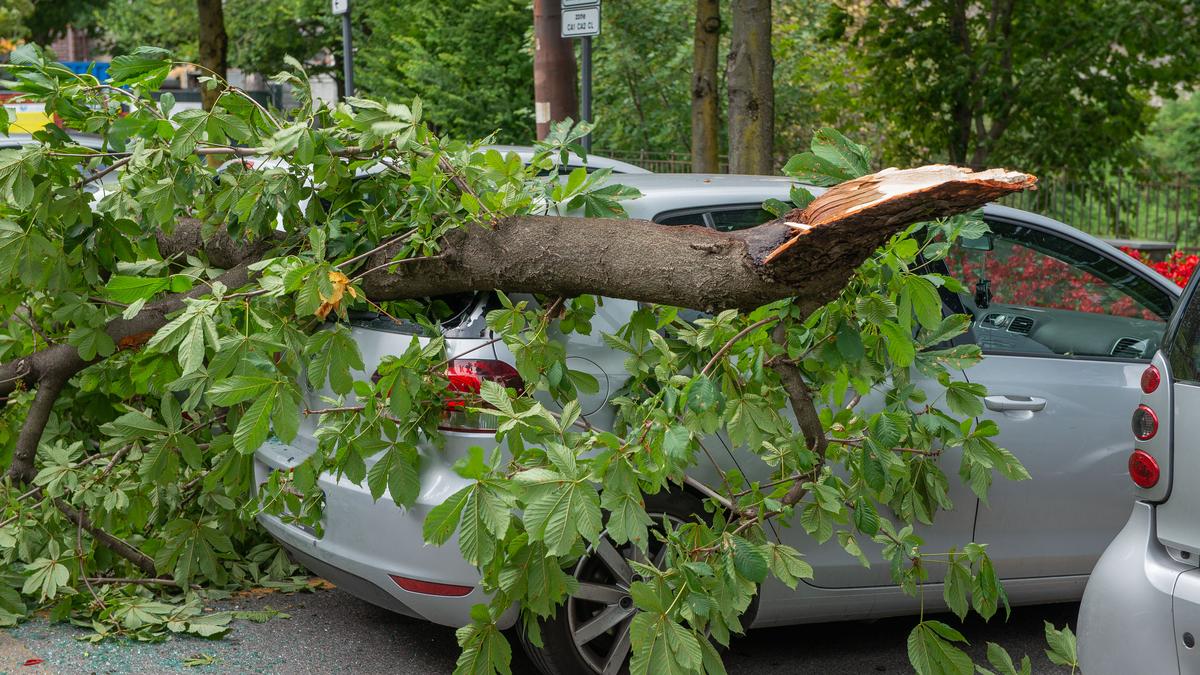
A fallen tree or branch landing on a car or a person is one of the most serious situations in which compensation can be claimed from the municipality. Most people assume that if a strong wind was blowing, "nobody is to blame". The courts, however, often take the opposite view: if the tree was dead, rotten or dangerous and this could have been seen, its owner is liable, even if it fell during a storm.
In this article you will learn who is responsible for trees in parks, along streets, in private gardens and in the yards of residential buildings; when a strong wind is "force majeure" and when it is not; how to claim compensation for a crushed car and for personal injury; the role of comprehensive (Casco) motor insurance and home insurance; and how real cases against municipalities have been decided.
Who is liable for a fallen tree?
The owner of the tree and the person who is legally required to maintain it are liable. So the first step is to establish whose land the tree was growing on.
Trees in parks, gardens and along streets: the municipality
Parks, gardens and street greenery form the basis of the municipal green system (Art. 61(2) of the Spatial Development Act, ЗУТ), and where they are owned by the municipality they are public municipal property (Art. 61(4)). The municipal council adopts an ordinance on the creation and protection of the green system (Art. 62(10) of the Spatial Development Act). These ordinances usually regulate inspections, pruning, removal of dangerous and dead trees, and the procedure for reporting problems.
When a national road passes through a town, the roadside greenery along it is organised by the relevant municipality (Art. 30(4) of the Roads Act). Outside towns and villages, trees within the boundaries of a national road usually fall within the responsibility of the Road Infrastructure Agency (Агенция „Пътна инфраструктура“); in case of doubt, check who owns the land.
Trees on private property: the owner
If the tree is in a private garden, the owner of the property is liable. The courts apply Art. 50 of the Obligations and Contracts Act (ЗЗД): the owner and the person in whose care a thing is are jointly and severally liable for damage caused by it. If the owner has property insurance with third-party liability cover, the compensation may be paid by the insurer.
Trees in the yard of a residential building
A tree in the yard of a building held as a condominium is usually the common responsibility of the owners in the building. If it falls on a parked car or a passer-by, the claim may be brought against them. In practice these cases are more complex, because it is necessary to establish exactly who owns the land: the yard may be common property, but it may also be municipal. Check the plot in the cadastre before taking action.
From our practice: Many people sue the municipality out of habit, only to find that the tree was on a private plot or in the yard of an apartment block. The claim against the municipality is then dismissed. A single cadastre check in the first few days can save you from losing the case.
On what legal basis is compensation claimed?
Claims against the municipality for damage caused by poorly maintained public areas are civil, not administrative. Joint Interpretative Ruling No. 2/2014 of the Supreme Court of Cassation and the Supreme Administrative Court holds that when maintaining its property the municipality acts as an owner, not as a public authority, and its liability is pursued under the Obligations and Contracts Act.
With trees, the courts apply two legal bases:
- Art. 49 in conjunction with Art. 45 of the Obligations and Contracts Act: the municipality is liable for the inaction of the employees and companies it has tasked with maintaining green spaces;
- Art. 50 of the Obligations and Contracts Act: the owner is liable for damage caused by its thing. For example, in the case of the man killed in Borisova Gradina park, the first-instance court applied precisely Art. 50.
Which classification the court chooses depends on the facts and on the particular panel. What matters for you is to describe exactly what happened and who owns the tree. The courts apply the same civil-law logic in other cases against municipalities, for example for a stray dog bite, where the municipality is liable for failing to supervise.
Storms and "force majeure": when does the wind clear the municipality?
This is the municipalities' most common defence. It sounds convincing, but the courts are reluctant to accept it.
What the courts mean by force majeure
Force majeure is an event that could not have been foreseen and whose consequences could not have been prevented with due care. It is not enough that a strong wind was blowing. The court examines whether the fall was foreseeable and preventable for the owner.
What the court looks at
Published judgments reveal several questions that the court seeks to answer:
- The condition of the tree: was it dead, rotten, leaning, hollow, bare of leaves in spring and summer?
- Earlier reports: had residents reported the dangerous tree; had any inspections been carried out?
- Conditions at the site: soil, drainage, planting density, the species' susceptibility to root rot.
- What measures the municipality took: inspection, pruning, removal, fencing off, warning signs, restricting access.
- The strength of the wind: an ordinary strong wind or a truly exceptional natural phenomenon. Data from the National Institute of Meteorology and Hydrology (НИМХ) for the day and any severe weather warnings are often discussed in the case.
When a storm may help the municipality
If the municipality proves that the tree was healthy, that it was inspected and maintained, and that it fell in a truly exceptional storm, the court may find that the damage could not have been prevented. The outcome depends on the evidence and on the court, so no general rule can be given. The logic of the case law is clear, however: the more visible the poor condition of the tree, the less the wind matters.
From our practice: An arboricultural (dendrological) expert report often decides the case. If the tree is cut up and taken away immediately, the evidence disappears. Photograph the stump, the point of breakage, the inside of the trunk and the neighbouring trees within the first few hours.
What to do immediately
- Photograph the spot with a landmark: a building number, a street sign, a bus stop. Photograph the car under the tree, the stump, the point of breakage, any rotten or dry heartwood and the neighbouring trees.
- Call 112, especially if someone is injured or the tree is blocking the street. Ask the police to document the damage to the car; insurers usually require such a document.
- If you are injured, go to an emergency department the same day and ask for a medical document describing the mechanism of the injury.
- Note down the witnesses: names and phone numbers of people who saw the fall or who know the tree had been dead for months.
- Submit a written report to the municipality or the district administration and keep the reference number. Ask whether there had been earlier reports and inspections of the same tree, including by a request under the Access to Public Information Act.
- Keep all receipts: for repairs, roadside assistance, taxis, medicines, examinations.
- Check the forecast and warnings for the day: you will need them to answer the force majeure argument.
A crushed car: compensation from the municipality or under Casco?
If you have Casco
The quickest route is usually to report the damage to your insurer. Many Casco policies cover falling trees and branches, but check the general terms and conditions of yours. Once it has paid, the insurer is subrogated to your rights against the person who caused the damage (Art. 410 of the Insurance Code) and itself recovers the amount from the municipality. You can claim the excess and any damage the insurer did not cover from the municipality yourself.
If you do not have Casco
You then sue the owner of the tree directly: the municipality, the owner of the private property or the co-owners of the building. The amount of the property damage is usually established by an automotive engineering expert report: the cost of repair at average market prices or, in the case of a total loss, the market value of the car. The logic of claims for damage to cars is described in detail in our article on accidents caused by a pothole.
A tree on a house, fence or roof
If the tree fell on your home, check your property insurance: many policies cover storms and falling trees. Watch out for the exclusions and for underinsurance, which we explain in our article on home insurance and refused claims. Here too, the insurer may recover what it has paid from the owner of the tree.
An injured person: what compensation is due?
Non-pecuniary damage
Pain, suffering, fear, lengthy treatment, limitations in daily life, lasting consequences. The court sets the amount on the basis of fairness (Art. 52 of the Obligations and Contracts Act), taking into account the injuries, operations, length of treatment and the victim's age. With children, the courts give particular weight to the psychological impact. In the event of death, the deceased's closest relatives may claim compensation.
Pecuniary damage
Costs of treatment, medicines, rehabilitation, mobility aids, transport, as well as lost income. Everything must be documented.
Interest
Statutory interest is due from the date of the damage, because in the case of a tort the debtor is in default even without a demand (Art. 84(3) of the Obligations and Contracts Act).
Contributory fault
The municipality may claim that the victim contributed to the damage, for example by parking or standing under a tree despite warnings or fencing. If this is proved, the compensation is reduced (Art. 51(2) of the Obligations and Contracts Act). Simply walking along a path or parking in a usual place is not contributory fault.
Real cases against municipalities
The following cases have been reported in the media and in legal publications.
- Borisova Gradina park, Sofia Court of Appeal, 2023. In 2015 a tree falls on a 41-year-old man on a path in the park and he is killed. The Sofia City Court awards his mother BGN 100,000 (≈ EUR 51,129), and the Court of Appeal upholds the judgment. The municipality argued force majeure: an apparently healthy tree with rotting roots. The court found that, given the heavy clay soil, poor drainage, the species' (red oak's) susceptibility to root rot and the density of the planting, the fall was foreseeable and the municipality should have ensured the safety of the paths. According to reports, the judgment is subject to cassation appeal.
- Dead linden tree in central Sofia, Sofia City Court, 2025. In June 2023 a linden tree falls on a 13-year-old girl on the pavement of Knyaz Boris I Street. The child suffers a skull fracture and other injuries. The court awards BGN 40,000 (≈ EUR 20,452) in non-pecuniary damages plus the costs of treatment. The expert report establishes that the tree was dead and the municipality should have removed it; the court finds that the fall was an inevitable consequence of its condition, not of external factors. At the time of publication the judgment was not final.
- Dead cherry plum in Plovdiv, Court of Appeal, 2025. In January 2023 the trunk of a dead cherry plum tree on Bogomil Street falls on a 13-year-old girl sitting on a bench, and she suffers a spinal fracture. The Court of Appeal awards BGN 50,000 (≈ EUR 25,565). The expert reports establish that the municipality had not removed the dead tree, and the municipality announces that it will not appeal.
- Rotten tree on cars in Ruse, Ruse District Court, 2016. A rotten tree about 12 metres tall falls in the wind onto cars parked on Tutrakan Boulevard. The court orders the municipality to pay BGN 1,156 (≈ EUR 591) for the damage to the car plus costs, finding that it must maintain the road and the green system next to it. The municipality announces that it will appeal.
A current case: Sliven, October 2026
On 14 October 2026, during strong winds in Sliven (reportedly with gusts above 70 km/h), a branch falls in the small garden next to the church of St Dimitar and seriously injures a man. According to media reports, the municipality sees no fault on its part: it states that the branch broke off a healthy tree and that risks cannot always be foreseen, even with apparently healthy trees.
We do not comment on this case or prejudge its outcome. It does, however, show the municipalities' typical defence. If it comes to court, the condition of the tree and the branch, inspections and pruning before the incident, residents' reports, weather warnings and the strength of the wind at the relevant moment will be examined. It is precisely on these questions that the cases described above were decided.
Deadlines, fees and which court
| Question | Answer | Legal basis |
|---|---|---|
| Limitation period | 5 years | Art. 110 of the Obligations and Contracts Act |
| Runs from | Identification of the person responsible (usually the day of the fall) | Art. 114(3) of the Obligations and Contracts Act |
| Court fee | 4% of the amount claimed, minimum EUR 25.56 | Tariff of State Fees under the Civil Procedure Code |
| First instance | District Court (районен съд); Regional Court (окръжен съд) for claims over BGN 25,000 (about EUR 12,782) | Art. 104(4) of the Civil Procedure Code |
| Interest | Statutory interest from the date of the damage | Art. 84(3) of the Obligations and Contracts Act |
The court may exempt a person without sufficient means from the court fee (Art. 83(2) of the Civil Procedure Code). The limitation period seems long, but the tree is usually cut up and removed within days. That is why the evidence must be gathered straight away, and it is sensible to consult a lawyer within the first few weeks. We explain what the whole case against the municipality looks like, step by step, in our guide how to sue the municipality for damage caused by poor infrastructure.
Frequently Asked Questions (FAQ)
Is the municipality liable if a tree falls on my car?
Yes, if the tree belongs to the municipality and the municipality failed in its duty to maintain it, for example by not removing a dead or rotten tree. If the tree is on private property or in the yard of a residential building, the owners are liable. See how the case against the municipality proceeds in our guide how to sue the municipality.
Does a strong wind release the municipality from liability?
Not automatically. The courts accept force majeure only if the fall could not have been foreseen and prevented with due care. If the tree was dry, rotten or had been reported before, the storm usually does not clear the owner. The outcome depends on the evidence and on the particular court.
What should I do if I have Casco insurance?
Report the damage to your insurer: many policies cover falling trees, but check the general terms and conditions. Once it has paid, the insurer is subrogated to your rights and itself recovers the amount from the municipality (Art. 410 of the Insurance Code). You can claim the excess and any uncovered damage yourself.
A tree fell on my house. Does my home insurance cover it?
Many policies cover storms and falling trees, but the terms vary. Check the exclusions and whether the property is underinsured. Read more in our article home insurance: flood, fire, theft and underinsurance.
Who is liable for a tree in the yard of an apartment block?
Usually the owners in the building, if the yard belongs to them. They are jointly and severally liable for damage caused by the thing (Art. 50 of the Obligations and Contracts Act). Check in the cadastre that the land is not municipal, because in that case the municipality is liable.
Can I sue a neighbour if their tree falls on my car?
Yes. The owner of the tree is liable under Art. 50 of the Obligations and Contracts Act for damage caused by their thing. If they have property insurance with third-party liability cover, their insurer may pay the compensation.
What evidence matters most when a tree falls?
Photographs of the tree, the stump and the point of breakage, witnesses who know about its condition, earlier reports to the municipality and medical documents if someone was injured. In court, the arboricultural expert report is key, so photograph everything before the tree is cut up.
How long do I have to bring a case?
The limitation period is 5 years (Art. 110 of the Obligations and Contracts Act) from the identification of the person responsible, which is usually the day of the fall. The evidence, however, disappears within days. Act straight away.
What amounts do the courts award for a fallen tree?
For damage to a car, the actual cost of repair plus interest and costs. For personal injury, the courts have awarded between BGN 40,000 and 50,000 to children with serious injuries, and BGN 100,000 in a case of death. You will find a comparison with other types of incident in our guide on compensation from the municipality.
Is the case similar to one about a pothole or a dog bite?
Yes, the logic is the same: the municipality is liable when it fails in its duty to maintain its property or to exercise supervision. See our articles on accidents caused by a pothole and stray dog bites.
Should I report a dangerous tree before it falls?
Yes, it helps everyone. A written report to the municipality with a reference number is strong evidence that the hazard was known. If the tree then falls and causes damage, the municipality will find it very hard to argue that the fall was unforeseeable.
How can we help you?
Fallen tree cases are won with evidence gathered quickly: photographs of the tree before it is cut up, witnesses to its condition and earlier reports. The municipality almost always relies on the storm in its defence, so it is important to prepare the answer to the force majeure argument from day one. You will find more on tort claims on the page of our civil lawyers.
Mechkova & Dimitrova Law Firm will establish who owns the tree, help you gather the evidence, draft the statement of claim and represent you in court, whether against the municipality, against the owner of the property or in a dispute with the insurer. The information in this article is general and does not guarantee any particular outcome. Contact us to have your case reviewed while the tree and the traces of the fall can still be documented.