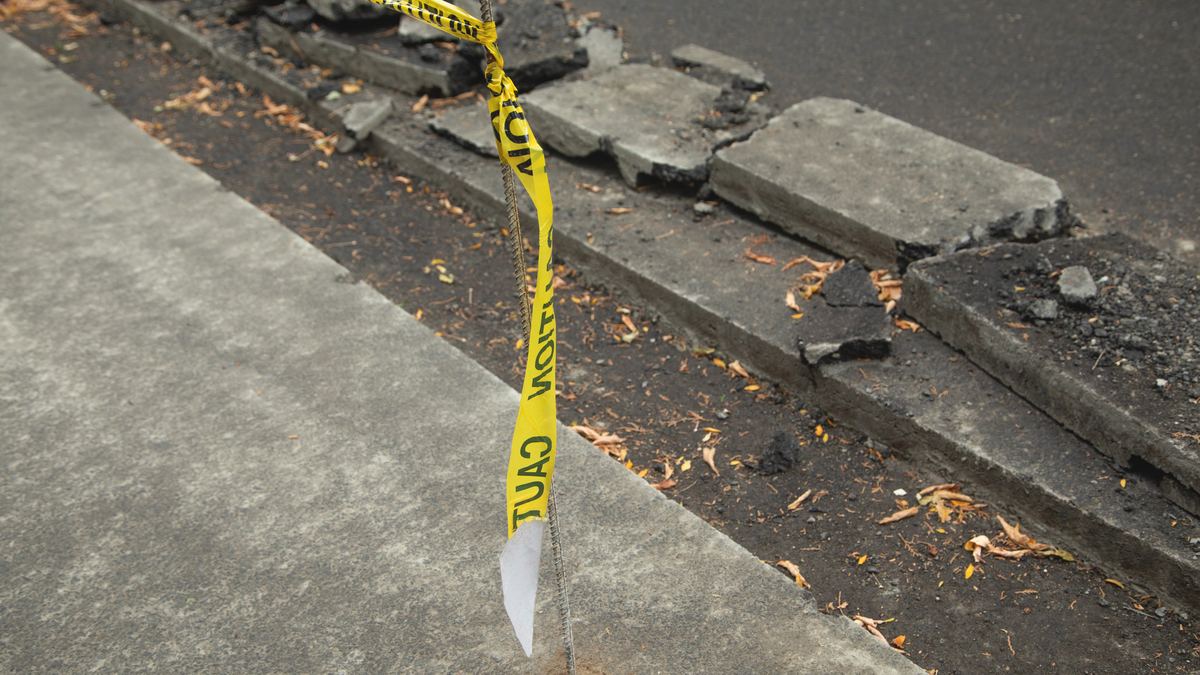
Compensation from the municipality for damage caused by poor infrastructure is available to anyone injured because of a pothole, a broken paving slab, an uncovered manhole, an unfenced excavation or a fallen tree. Most people put such incidents down to bad luck, but the law makes a specific owner, most often the municipality, responsible for maintaining streets, pavements and green spaces. When that maintenance is lacking and someone is hurt, the courts award compensation for pain, medical treatment, car repairs and lost income.
In this guide you will learn how to sue the municipality or another responsible owner: how to establish who is liable, on what legal basis the case is brought, what to do immediately after the incident, what evidence decides the dispute, how much time you have, how much it costs and what amounts the courts award in real cases. At the end you will find a short overview of the most common situations, with links to our detailed articles.
Who is liable: the municipality, the Road Infrastructure Agency or another owner?
The first question in every case is against whom the claim should be brought. The owner, or the person who by law manages the facility, is liable. If you sue the wrong defendant, the claim will be dismissed even if the damage is undisputed.
Streets, pavements and municipal roads
Streets in towns and villages and municipal roads are maintained by the municipality. The Roads Act expressly provides that the construction, repair and maintenance of municipal roads are carried out by the municipalities (Art. 31 of the Roads Act), and their management is entrusted to the mayors (Art. 19(1)(2)). The Roads Act does not apply to streets (Art. 1(2)(1)), but streets are municipal property and the duty to maintain them again lies with the municipality.
National roads: the Road Infrastructure Agency
Motorways and first-, second- and third-class roads are national roads. They are maintained by the Road Infrastructure Agency (Агенция „Пътна инфраструктура“, АПИ) (Art. 30(1) of the Roads Act). When a national road passes through a town, responsibility is divided: the pavements, underground facilities, cycle lanes, lighting and roadside greenery along it are organised by the municipality (Art. 30(4)), while for settlements of up to 100,000 inhabitants the Road Infrastructure Agency is responsible for routine repairs and winter maintenance of the carriageway itself (Art. 30(5)). In case of doubt, it is sensible to bring the claim against both possible defendants.
Manholes, cables and pipes: water utility, energy company, telecoms operator
A manhole on the pavement does not always belong to the municipality. Water supply and sewerage covers usually belong to the water utility (ВиК operator), those of the electricity distribution network to the energy company, and cable covers to the telecommunications operator. The courts dismiss claims against the municipality when it turns out that the facility belongs to another owner. We explain in detail how to find out whose manhole it is in our article I fell into a manhole or trench: who pays?.
Excavations and roadworks: the contractor
When the incident happens in a roadworks zone, the damage is often caused by the contractor that failed to fence off or light the excavation. The principal, usually the municipality or the utility company, is also liable for the work it commissioned. The Supreme Court of Cassation has held, for example, that the municipality is liable for damage caused by the company it hired to clean the streets, and that the contractual penalties in its contract with that company do not shift that liability. Where damage is caused by several persons, they are jointly and severally liable (Art. 53 of the Obligations and Contracts Act), so in practice it is considered whether to sue both.
Trees
Trees in parks, gardens and street greenery form part of the municipal green system (Art. 61 of the Spatial Development Act), and the municipal council adopts an ordinance on its creation and protection (Art. 62(10) of the Spatial Development Act). A tree in a private garden or in the yard of a residential building is the responsibility of the owners of that property.
How to check who the owner is
- Look closely at the facility. Manhole covers often bear the owner's logo or name. Photograph it close up.
- Check the plot in the cadastre. The cadastral map shows the plot number and its ownership: street, park, private plot.
- Send a written enquiry to the municipality or the district administration. You can also request information under the Access to Public Information Act, for example who maintains the section and whether there is a contract with a company.
- Get advice early. In case of doubt, your lawyer can bring the claim against more than one defendant or ask for a third party to be joined to the proceedings.
On what legal basis is compensation claimed?
The duty to maintain roads and pavements is not an exercise of public authority but an economic activity: the municipality acts as an owner. That is why the case is a civil one. This was confirmed by joint Interpretative Ruling No. 2/2014 of the General Assembly of the Civil College of the Supreme Court of Cassation and the First and Second Colleges of the Supreme Administrative Court, dated 19 May 2015: claims for damage caused by transport and communication networks and facilities owned by the state and municipalities fall within the jurisdiction of the civil courts. The municipality's liability is in tort and is pursued under the Obligations and Contracts Act (ЗЗД), not under the State and Municipalities Liability for Damage Act (ЗОДОВ).
In practice, the claim is most often classified under Art. 49 in conjunction with Art. 45 of the Obligations and Contracts Act: the municipality is liable for the unlawful inaction of the employees tasked with maintenance, even if it is impossible to identify which specific employee failed to act. For damage caused by the thing itself, such as a fallen tree, the courts sometimes also apply Art. 50 of the Obligations and Contracts Act (liability of the owner and of the person in whose care the thing is). The legal classification depends on the facts and on the court; your task is to describe accurately what happened.
This is different from administrative disputes with the municipality, such as appeals against a fine, towing or wheel clamping, which are conducted under the Administrative Violations and Sanctions Act (ЗАНН) and the Administrative Procedure Code (АПК). For those, see our article on appealing municipal fines, towing and wheel clamping.
From our practice: In these cases the municipality must prove that it kept the facility in good condition. If the victim proves the hole, the fall and the damage, and the municipality produces no evidence of maintenance, warning signs or repairs, the claim is usually upheld.
What to do immediately after the incident
Evidence from the first few hours often decides the case. Use this checklist:
- Photograph the spot with a landmark: a building number, a street sign, a bus stop, a pedestrian crossing. Place an object next to the hole for scale (keys, a shoe, a tape measure). Take both wide and close-up shots.
- Note down the witnesses: names and phone numbers of the people who saw the fall or helped you.
- Go to an emergency department the same day. Ask for an outpatient record (амбулаторен лист) or discharge summary (епикриза) recording the date, place and mechanism of the injury.
- If your car is damaged, call 112 and ask for the police to attend. Insurers usually require a police document.
- Submit a written report to the municipality (or to the Road Infrastructure Agency, the water utility or the energy company) and get a reference number. It proves that the owner was notified and often shows when the hazard was removed.
- Keep all receipts: medicines, dressings, examinations, rehabilitation, taxis, repairs, roadside assistance.
- Do not throw away damaged items: a tyre, a wheel rim, a shoe, a broken phone.
Step by step: from the incident to the court's judgment
- Gathering evidence: following the checklist above, in the first few days.
- Identifying the defendant: the municipality, the Road Infrastructure Agency, a utility company or a contractor (see the first section).
- Analysing the case: assessing the prospects, the amount of the claim and the risk of an objection of contributory fault. If you are looking for a lawyer, see which questions to ask a lawyer.
- Letter to the defendant (optional): not mandatory, but it sometimes leads to an out-of-court payment or at least shows the municipality's position.
- Statement of claim: filed with the evidence and the paid court fee. Non-pecuniary and pecuniary damage are stated separately.
- The defendant's response: the municipality usually disputes the place, the mechanism, ownership of the facility and the amount of the damage, and raises an objection of contributory fault.
- Evidence in court: examination of witnesses, forensic medical, automotive engineering or arboricultural (dendrological) expert reports, information from the municipality on maintenance.
- Judgment and appeal: the first-instance judgment can be appealed. Once it becomes final, the defendant pays the principal, interest and costs; if it does not pay, enforcement proceedings are opened.
The length of the case depends on the court's workload and on the expert reports: the first instance usually takes months, and with appeals the case may last years.
What evidence decides the case?
You need to prove four things:
- The place and the hazard: photographs, witnesses, a report to the municipality, a police report.
- The mechanism of the incident: exactly how you fell or how the car hit the hole. Witnesses are key.
- The damage: medical records, invoices, an expert report.
- The causal link: that the damage occurred precisely because of the hazard. Here the court usually relies on an expert report.
The municipality, for its part, must prove that it fulfilled its obligations: that the section was maintained, made safe or signposted. Earlier reports by residents about the same pothole or the same tree are strong evidence that the hazard was known.
Deadlines, fees and which court
| Question | Answer | Legal basis |
|---|---|---|
| Limitation period | 5 years | Art. 110 of the Obligations and Contracts Act |
| Runs from | Identification of the person responsible (usually the day of the incident, if the owner is known) | Art. 114(3) of the Obligations and Contracts Act |
| Court fee | 4% of the amount claimed, minimum EUR 25.56 | Tariff of State Fees under the Civil Procedure Code |
| Exemption from the fee | Where the claimant lacks means, at the court's discretion | Art. 83(2) of the Civil Procedure Code |
| First instance | District Court (районен съд); Regional Court (окръжен съд) for claims over BGN 25,000 (about EUR 12,782) | Art. 104(4) of the Civil Procedure Code |
| Interest | Statutory interest from the date of the damage | Art. 84(3) of the Obligations and Contracts Act |
The claim may be brought where the defendant has its seat or where the damage occurred. In addition to the court fee, you should budget for deposits for expert reports and the lawyer's fee. If you win, the court orders the defendant to reimburse your costs in proportion to the part of the claim upheld. Since 1 January 2026, the statutory interest rate has been equal to the ECB's main refinancing operations rate plus 8 percentage points (Council of Ministers Decree No. 347/2025).
Five years sounds like a long time, but evidence disappears quickly: the pothole is filled in, the slab is replaced, the tree is cut down. Act within the first few weeks.
What does compensation from the municipality cover?
Non-pecuniary damage
Pain, suffering, fear, sleeplessness, limitations in daily life, scarring, lasting consequences. The court sets the amount on the basis of fairness (Art. 52 of the Obligations and Contracts Act), considering the type of injury, operations, length of treatment, age and lasting consequences. In the event of death, the deceased's closest relatives receive compensation.
Pecuniary damage
The costs actually incurred: treatment, medicines, rehabilitation, mobility aids, transport, the repair cost or market value of the damage to the car, income lost during temporary incapacity for work. Everything must be documented.
Interest and costs
Statutory interest is due on the compensation from the date of the damage, because in the case of a tort the debtor is in default even without a demand (Art. 84(3) of the Obligations and Contracts Act). The costs of the proceedings are added to this.
Contributory fault: when the amount is reduced
The municipality almost always claims that the victim was to blame: they did not look where they were going, drove too fast, walked across a grassed area. If the court accepts that the victim contributed to the damage, the compensation is reduced (Art. 51(2) of the Obligations and Contracts Act). The burden of proving this lies with the defendant.
How the court assesses the objection depends on the facts and on the panel. In one case concerning a broken ankle on sunken paving slabs, the Sofia City Court reduced the compensation, finding that the unevenness could have been seen while walking normally. In other cases, involving an unfamiliar water-filled pothole in the carriageway and an unlit excavation, the objection was rejected. That is why photographs of the lighting, visibility and warning signs are so important.
How much do the courts award? Indicative amounts
There is no table that the court uses to set compensation. Here is a guide based on the real cases we look at in this series (amounts are in leva as reported, with the approximate equivalent in euro):
| Type of injury or damage | Non-pecuniary damages awarded | Example from practice |
|---|---|---|
| Car damage from a pothole | The actual repair cost + interest and costs | BGN 3,898 (≈ EUR 1,993) and BGN 6,557 (≈ EUR 3,353) against Sofia Municipality |
| Simple fracture | BGN 5,000 – 20,000 (≈ EUR 2,556 – 10,226) | BGN 12,000 for a dislocated shoulder and broken bone after a fall into a manhole |
| Fracture requiring surgery | BGN 15,000 – 35,000 (≈ EUR 7,669 – 17,895) | BGN 35,000 for a fall into an open manhole on a pedestrian crossing |
| Serious consequences for daily life | BGN 40,000 – 80,000 (≈ EUR 20,452 – 40,903) | BGN 40,000 for a child struck by a dead tree |
| Permanent injury / death | up to BGN 100,000 – 180,000 (≈ EUR 51,129 – 92,033) | BGN 180,000 for a fall into an unfenced excavation |
The table is a guide, not a promise. Every case is different, and the courts also take into account when the damage occurred and the economic situation.
Real cases against municipalities
The following cases have been reported in the media and in legal publications. They show how the courts reason in different situations.
- Pothole in the carriageway, Sofia City Court, 2025. A car drives into an unsecured, unmarked, water-filled pothole on Akad. Rostislav Kaishev Street in Sofia. The comprehensive (Casco) motor insurer pays BGN 6,557 (≈ EUR 3,353) and successfully recovers it from Sofia Municipality together with interest and costs, around BGN 7,700 (≈ EUR 3,939) in total. The judgment of 17.04.2025 is not subject to appeal.
- Sunken paving slabs, Sofia City Court, 2020. A woman breaks her ankle on a broken-up pavement in central Sofia. The court sets compensation at BGN 20,000 but reduces it to BGN 16,000 (≈ EUR 8,181) for contributory fault. The municipality did not prove that it had maintained the pavement. At the time of publication the judgment was not final.
- Unfenced excavation near the National Palace of Culture (НДК), final in 2022. A 17-year-old falls one evening into a three-metre-deep excavation in a roadworks zone: unlit, without warning signs and without adequate fencing. BGN 180,000 (≈ EUR 92,033) is awarded in non-pecuniary damages, the objection of contributory fault is rejected, and the Supreme Court of Cassation refuses to allow a cassation appeal.
- Fallen tree in Borisova Gradina park, Sofia Court of Appeal, 2023. The Court of Appeal upholds BGN 100,000 (≈ EUR 51,129) for the mother of a man killed by a falling tree. The court rejects the force majeure argument: given the soil, drainage and tree species, the fall was foreseeable. According to reports, the judgment is subject to cassation appeal.
- Icy street, Supreme Court of Cassation, 2019. The Supreme Court of Cassation overturns the judgment of the Plovdiv Court of Appeal and orders Plovdiv Municipality to pay BGN 20,000 (≈ EUR 10,226) to a woman who broke her leg on the icy carriageway. She was walking in the road because the pavements had not been cleared of snow. The municipality is also liable for the company it hired to clear the snow.
- Case lost through the wrong defendant, Plovdiv, 2025. A man falls into an uncovered manhole and breaks a toe, but his claim against Plovdiv Municipality is dismissed because the facility belongs to a mobile operator. The lesson: establish the owner first.
The scale of the problem is also shown by figures that Sofia Municipality provided to the media in 2026: from the beginning of 2021 to August 2026 the municipality paid around EUR 1.8 million in cases over damage to cars from the municipal road network, and 267 cases were pending.
A short overview of the most common situations
A pothole and damage to your car
If your car has been damaged by a pothole, you have two options: sue the municipality or the Road Infrastructure Agency directly, or receive compensation under your comprehensive (Casco) policy and let the insurer recover the amount from them. We explain how the mechanism is proved and when the driver bears part of the blame in our article on accidents caused by a pothole.
A broken or sunken paving slab
Falls on pavements are the most common case for pedestrians, especially elderly people. You will find more on proof and on the objection that the victim "did not look where they were going" in our article I tripped on a broken paving slab.
A manhole or excavation
Here the most important thing is to establish the owner: the municipality, the water utility, the energy company, the telecoms operator or the contractor. See who pays after a fall into a manhole or trench.
A fallen tree or branch
With trees, the decisive question is whether the fall was foreseeable (rot, the tree having died, earlier reports) or was caused by a truly exceptional storm. Read more in our article on a fallen tree or branch hitting a car or a person.
A stray dog bite
The logic is the same: the municipality is liable for failing to fulfil its obligations, this time under the Animal Protection Act. See compensation from the municipality for a dog bite.
Ice and uncleared snow
The municipality must also clear streets and pavements in winter. If you fall on an icy, uncleared pavement, or are forced to walk in the road because the pavement is impassable, you can also claim compensation. Photographs taken the same day and witnesses are especially important here, because ice disappears quickly.
Frequently Asked Questions (FAQ)
Can you really sue the municipality over a pothole or a broken paving slab?
Yes. The municipality is liable as owner for maintaining streets and pavements, and the claims are heard by the civil courts under the Obligations and Contracts Act. You need to prove the place, the mechanism of the incident and the damage. For more on pavements, see our article I tripped on a broken paving slab.
How do I find out whether the road belongs to the municipality or the Road Infrastructure Agency?
Streets in towns and villages and municipal roads belong to the municipality, while motorways and first- to third-class roads belong to the Road Infrastructure Agency. When a national road passes through a town, the pavements, lighting and underground facilities along it are organised by the municipality. In case of doubt, send a written enquiry or bring the claim against both.
Who pays if the manhole does not belong to the municipality?
The owner of the facility: the water utility, the energy company or the telecoms company. If you sue the municipality and the manhole turns out to belong to another owner, the claim will be dismissed. We explain how to establish the owner in our article I fell into a manhole or trench.
How long do I have to sue the municipality?
The limitation period is 5 years (Art. 110 of the Obligations and Contracts Act) and runs from the identification of the person responsible (Art. 114(3)), which usually coincides with the day of the incident. Do not wait: evidence at the scene disappears within days or weeks.
How much does the case cost?
The court fee is 4% of the amount claimed, but not less than EUR 25.56. Deposits for expert reports and the lawyer's fee are added to this. If you win, the defendant reimburses your costs in proportion to the part of the claim upheld.
Do I first have to file a complaint with the municipality?
It is not a precondition for the claim. A written report is, however, useful evidence of the place and of the fact that the municipality knew about the hazard. Municipalities rarely pay voluntarily, so most cases end up in court.
My car hit a pothole. Should I claim under my Casco policy or from the municipality?
Both routes are possible. With Casco you get the money faster, and the insurer is subrogated to your rights and itself recovers the amount from the municipality or the Road Infrastructure Agency. Without Casco, you sue directly. Read more in our article on accidents caused by a pothole.
Will the compensation be reduced if I wasn't looking where I was going?
It may be. If the court finds contributory fault, the compensation is reduced (Art. 51(2) of the Obligations and Contracts Act), but the municipality must prove it. Whether the objection is upheld depends on visibility, lighting and the particular court.
Is the municipality liable for a tree that falls during a storm?
It depends on whether the fall was foreseeable. If the tree was dead, rotten or had been reported before, the courts usually do not accept the storm as force majeure. See the analysis in our article on a fallen tree or branch.
Can I get compensation for a bite from a stray dog?
Yes. The municipality is responsible for supervising stray dogs, and the courts award compensation for bites. The details are in our article on stray dog bites.
Is this different from appealing a fine from the municipality?
Yes. A claim for damages is a civil case under the Obligations and Contracts Act, whereas an appeal against a fine, towing or wheel clamping is an administrative dispute under the Administrative Violations and Sanctions Act or the Administrative Procedure Code. See how municipal fines are appealed.
How much can I get for a broken leg?
There is no fixed amount. For a simple fracture the courts award roughly BGN 5,000 to 20,000 (≈ EUR 2,556 – 10,226), and more where surgery and a long recovery are involved. The amount is set on the basis of fairness according to the specific consequences.
How can we help you?
Cases against municipalities and companies look simple, but they are won or lost on the details: the right defendant, the photographs from the first day, the witnesses and the expert report. The municipality almost always disputes the mechanism of the incident and raises an objection of contributory fault, so preparation is decisive. You will find more on tort claims on the page of our compensation claims lawyers in Sofia.
Mechkova & Dimitrova Law Firm will assess whom the claim should be brought against, help you gather the evidence, draft the statement of claim and represent you in court. The information in this article is general and does not guarantee any particular outcome. Contact us to have your case reviewed while the traces of the incident are still there.