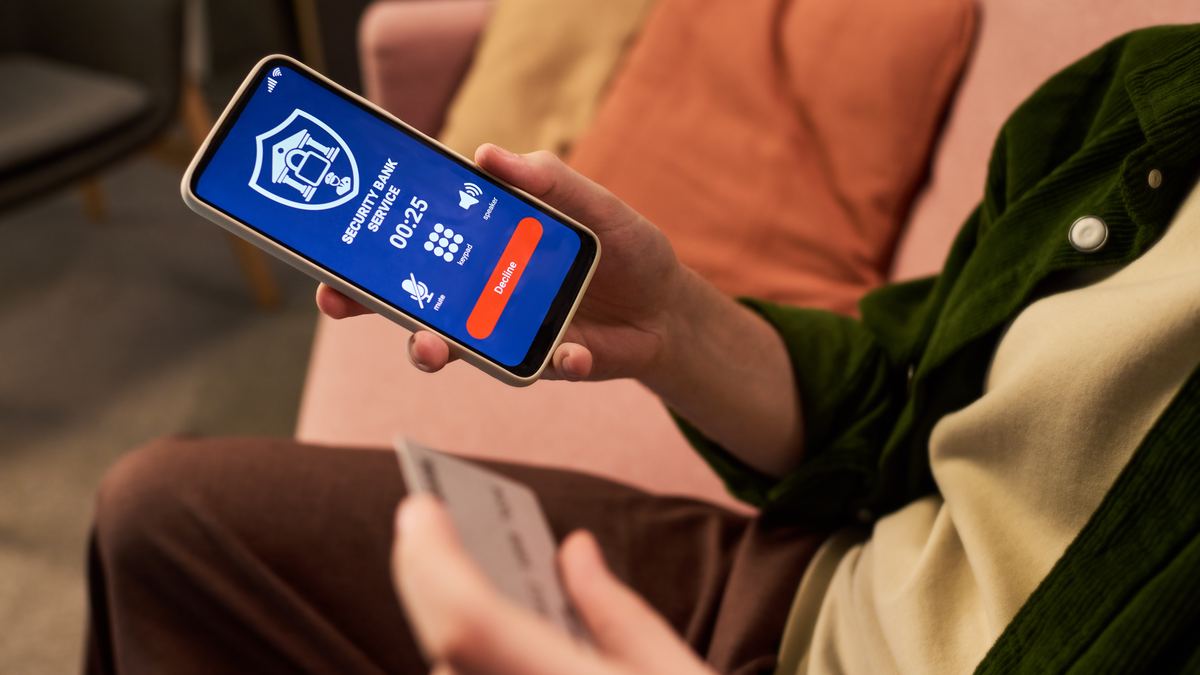
Vishing is fraud by telephone: a caller claiming to be "from the bank's Security department", "a police officer" or "an official of the Bulgarian National Bank (БНБ)" convinces you that your money is in danger. The solution they offer is always the same: transfer it immediately to a "safe account". The call sounds professional, the number on the screen often matches the bank's real number, and the caller knows your name and some of your details. Minutes later, your savings are in the account of a stranger.
This article is about the hardest case: when you yourself ordered the transfer. In that situation, the protection for unauthorised transactions under the Payment Services and Payment Systems Act (ЗПУПС) as a rule does not apply, and the bank often answers briefly: "the operation was confirmed by you". That does not mean the money is lost, however. We explain what to do in the first hours, against whom the amount can be claimed (the recipient, their bank and sometimes your own bank) and where the outcome depends on the court. If it was not you but the fraudster who ordered the payment using your details, read our article on unauthorised transactions from a card or account.
How the "safe account" scheme works
The scenarios differ in the details, but they follow a similar pattern:
- A call from a spoofed number. The number of the bank or the police is displayed. Number spoofing is a technical trick and does not prove that the call is genuine.
- Alarming news. "Someone is trying to take out a loan in your name", "a transfer is leaving your account", "a bank employee is an accomplice".
- Isolation. You are told not to speak to anyone at the branch, because "people there are involved too".
- Instructions to transfer. You order a transfer to a "safe account", sometimes after being made to take out a loan or close a deposit. You may also be asked to install a remote access app.
- Repetition. If the first transfer goes through, new calls follow for an "additional check".
The recipient account usually belongs to a third party, a so-called money mule, who has provided their account in exchange for payment or opened an account on the fraudsters' instructions. The money is moved on within minutes or hours.
A close variant is the call from a "broker" promising profits from cryptocurrencies or shares. The legal questions are the same. Check whether the company has a licence in the registers and warnings of the Financial Supervision Commission (Комисия за финансов надзор).
From our practice: A real bank never asks you to move your money to a "protected" or "safe" account, to share a code or to install a remote access program. As soon as you hear these words, end the call and ring the number on the back of your card yourself.
Authorised or unauthorised operation: why this is the key question
Under Art. 70(1) of the Payment Services and Payment Systems Act, a payment transaction is authorised if the payer ordered it or consented to its execution. The law makes no distinction as to whether consent was given under the influence of fraud. So when you entered the recipient and the amount and confirmed the transfer, the bank usually takes the view that the transaction was authorised. In that case, the rules on immediate refund (Art. 79 of the Payment Services and Payment Systems Act) and on limited liability of up to EUR 50 (Art. 80 of the Payment Services and Payment Systems Act) do not apply.
The line, however, is not always clear:
- if the fraudster controlled your device remotely and entered the transfer themselves, it can be argued that the transaction was unauthorised;
- if you read out a code from an SMS without knowing that it confirmed this particular transfer, there are also arguments for an unauthorised transaction;
- if you ordered the transfer knowingly, believing that you were protecting your money, the transaction is as a rule authorised.
How the transaction will be classified depends on the evidence: what exactly you did, what the confirmation message said, what traces there are in the bank's systems. The courts are not unanimous on this question, so describe the facts precisely and do not accept without analysis the bank's position that "you did everything yourself".
The first hours: what to do
- Call your bank immediately. Ask for all pending transactions to be stopped, access to online banking to be blocked and an attempt to be made to recall the transfer through the recipient's bank. A payment order cannot be revoked once the bank has received it (Art. 85(1) of the Payment Services and Payment Systems Act), but if the recipient's bank is notified in time, it may hold or block the funds under its own anti-fraud rules.
- Send a written notification. Describe the chronology, the amount, the IBAN and the name of the recipient, and ask for a reference number. A written trail is decisive for any later dispute.
- Report it to the police or to the Chief Directorate for Combating Organised Crime (Главна дирекция „Борба с организираната престъпност“). The fraudsters' actions are usually prosecuted as fraud or computer fraud (Art. 209 and Art. 212a of the Criminal Code), and the report allows the prosecution to request information about the recipient's account.
- Preserve the evidence. Screenshots of the calls, the numbers, the SMS messages, the apps you installed, the correspondence. Do not reset your phone before it has been examined.
- Change your passwords and uninstall any remote access programs.
- Beware of a second scam. "Recovery agencies" that promise to get the money back for a fee are almost always the same scheme.
Can your bank be liable?
There is no automatic right to a refund for an authorised transfer. However, the liability of the payer's bank is not excluded in every case. It is assessed according to the bank's specific obligations:
Verification of payee (IBAN and name)
Regulation (EU) 2024/886 requires banks to offer verification of payee for credit transfers in euro: before you confirm the transfer, the bank checks whether the name you entered matches the holder of the IBAN and notifies you if it does not. For banks in Bulgaria this duty applies from 1 January 2027 at the latest, one year after the euro was introduced (Art. 16(9) of Regulation (EU) No 260/2012), and some banks already offer the check. The Regulation applies directly. If the bank was required to carry out the check or offers it, but did not do so, and the transfer went to another person's account, this may be a ground for its liability. If, however, you received a mismatch warning and went ahead, the protection as a rule falls away. In vishing cases, the check often shows a "match", because you are told the real name of the money mule. In that case, this argument does not help.
Monitoring of unusual transactions and warnings
Banks must maintain transaction monitoring mechanisms to detect unauthorised and fraudulent payments (Art. 2 of Delegated Regulation (EU) 2018/389). A large transfer to a new account, immediately after a loan has been drawn down or a deposit closed, with unusual behaviour in the app, is a typical risk signal. Whether failing to stop such a transfer is a breach of contract that makes the bank liable is disputed and depends on the court. If the court accepts such liability, the compensation may be reduced because of your own contribution (Art. 51(2) of the Obligations and Contracts Act, ЗЗД).
What is coming at EU level
A political agreement has been reached at EU level on a new Payment Services Regulation. It provides for the bank to refund the amount where the fraudster impersonated a bank employee and the customer promptly notified the police and the bank. At the time of writing, the Regulation does not apply. It is expected to start applying around 2027–2028, so you cannot rely on it today.
Complaint, Conciliation Committee, court
The bank must respond to a written complaint within 15 business days, and exceptionally within 35 business days (Art. 174(3) and (4) of the Payment Services and Payment Systems Act). If it refuses or does not respond, you can turn to the Conciliation Committee for Payment Disputes (Art. 174(5) of the Payment Services and Payment Systems Act), file a complaint with the Bulgarian National Bank or bring a claim. We explain how each of these routes works in our article on unauthorised transactions and the bank's refusal.
A claim against the recipient of the money
The most secure legal basis is usually against the person into whose account the money was paid.
Unjust enrichment. Anyone who has received something without legal grounds must return it (Art. 55(1) of the Obligations and Contracts Act). There is no transaction at all between you and the account holder, so the amount was received without grounds. You do not need to prove that the recipient knew about the fraud.
Tort. If the recipient knowingly took part in the scheme, they are also liable for the damage under Art. 45 of the Obligations and Contracts Act, jointly and severally with the other participants (Art. 53 of the Obligations and Contracts Act). With such a claim the debtor is in default even without a demand (Art. 84(3) of the Obligations and Contracts Act), while with a claim under Art. 55 of the Obligations and Contracts Act interest usually runs from the demand. You can calculate the amount of interest with our statutory interest calculator.
Limitation. The general period is five years (Art. 110 of the Obligations and Contracts Act). In the case of a tort, it runs from the identification of the perpetrator (Art. 114(3) of the Obligations and Contracts Act).
Practical steps
- Identify the recipient. The account holder's name is often visible in the transfer. The recipient's bank keeps their full details as banking secrecy and as a rule discloses them to the prosecution or the investigating authorities, not to you. This is why the police report is also a means of gathering evidence for the civil case.
- Secure the claim. If the amount is still in the account, ask the court for interim measures securing a future claim in the form of a garnishment (Art. 389–391 of the Civil Procedure Code, ГПК). The court sets a period of up to one month within which you must bring the claim (Art. 390(3) of the Civil Procedure Code).
- Choose the procedure. For an undisputed amount, an order for payment procedure under Art. 410 of the Civil Procedure Code is possible, and if the debtor objects, ordinary claim proceedings. In criminal proceedings you can also bring a civil claim as the injured party (Art. 84 of the Criminal Procedure Code).
- Collect the claim. With a writ of execution you move on to compulsory enforcement through a private enforcement agent. We describe how this works in our article unpaid invoice: from demand letter to bailiff.
You can calculate the state fees for the claim or the application in advance with our court fees calculator.
A claim against the recipient's bank
This route is harder. The argument is that the recipient's bank opened or maintained a money mule's account without complying with its know-your-customer obligations under the Measures Against Money Laundering Act (ЗМИП), or failed to react to obvious signals: dozens of incoming transfers from different people, immediately withdrawn or forwarded. The claim is usually built as a tort (Art. 45 and Art. 49 of the Obligations and Contracts Act).
You should know the risks:
- the obligations under the Measures Against Money Laundering Act are public-law obligations, and the court may find that they do not give rise to rights for an individual victim;
- a causal link between the bank's omission and your loss is hard to prove;
- the evidence of how the account behaved is held by the bank and is usually gathered through the pre-trial proceedings or through a request to the court;
- the case law on such claims in Bulgaria is sparse and not settled.
This claim is therefore reasonable mainly for large amounts and good evidence, most often together with the claim against the recipient.
| Against whom | Legal basis | What must be proven | Note |
|---|---|---|---|
| The recipient of the money | Art. 55(1) of the Obligations and Contracts Act | the transfer and the lack of legal grounds | the most secure route |
| The recipient, if an accomplice | Art. 45 and 53 of the Obligations and Contracts Act | fault and damage | fault is presumed (Art. 45(2) of the Obligations and Contracts Act) |
| Your bank | the contract, the Payment Services and Payment Systems Act, Regulation 2024/886 | a specific obligation breached | depends on the facts and the court |
| The recipient's bank | Art. 45 and 49 of the Obligations and Contracts Act, in conjunction with the Measures Against Money Laundering Act | an omission and a causal link | the case law is not settled |
How to build the evidence
Prepare a chronology with exact times: the calls, the transfers, the notifications to the bank and the police. Ask the bank in writing by what means each transaction was confirmed, from what device and IP address, whether verification of payee was carried out and what its result was. Keep the police file number and all of the bank's replies. If you are looking for a banking disputes lawyer in Sofia, this is exactly the file you will need. We explain what to ask at the first meeting in our article how to choose a good lawyer.
Frequently Asked Questions (FAQ)
What is vishing?
Vishing is telephone fraud in which someone poses as an employee of a bank, the police or another institution to make you disclose details or transfer money. The number on the screen may be spoofed, so it does not prove that the call is genuine.
Is the bank obliged to refund my money if I ordered the transfer myself?
Not automatically. Because you ordered the transfer, it is as a rule authorised under Art. 70 of the Payment Services and Payment Systems Act, and the refund obligation under Art. 79 of the Payment Services and Payment Systems Act does not apply. The bank can be liable only where a specific obligation was breached, and this is assessed case by case.
The fraudster controlled my phone remotely. Did I order the transfer?
Not necessarily. If the fraudster entered and sent the transfer themselves, there are arguments that the transaction was unauthorised, and then the rules of Art. 78–80 of the Payment Services and Payment Systems Act apply. We describe how they work in our article on unauthorised transactions.
Can the transfer be stopped?
A payment order cannot be revoked once the bank has received it (Art. 85(1) of the Payment Services and Payment Systems Act). If, however, you notify the bank immediately, it can contact the recipient's bank, which sometimes manages to hold the funds. Every minute counts.
Can I sue the person into whose account the money went?
Yes. A claim for the return of what was received without legal grounds can be brought against the recipient (Art. 55(1) of the Obligations and Contracts Act), and if they are an accomplice, also a claim for damages under Art. 45 of the Obligations and Contracts Act. For an undisputed amount, you can start with an order for payment procedure.
How do I find out who the recipient is?
The name is often visible in the transfer, but the full details are covered by banking secrecy. They are most often obtained through the pre-trial proceedings, which is why the police report also matters for the civil case.
Is the recipient's bank liable?
It may be, if it allowed a money mule to open or use an account in breach of its know-your-customer obligations. The case law on such claims in Bulgaria is not settled, and proof is difficult.
What is verification of payee and does it help with vishing?
It is a check of whether the name you entered matches the holder of the IBAN, mandatory for transfers in euro under Regulation (EU) 2024/886 (for banks in Bulgaria from 1 January 2027 at the latest). In vishing cases it often shows a match, because you are told the real name of the money mule, so it does not always help.
Is there a deadline for bringing a claim?
The general limitation period is five years (Art. 110 of the Obligations and Contracts Act), and in the case of a tort it runs from the identification of the perpetrator (Art. 114(3) of the Obligations and Contracts Act). The chances of actually recovering the amount, however, decrease with every day, so do not wait for the end of the period.
How is the amount collected if I win the case?
With a writ of execution and a private enforcement agent: garnishment of the debtor's accounts, salary and property. The steps are described in our article unpaid invoice: from demand letter to bailiff.
When is it worth hiring a lawyer?
When the amount is significant, when the recipient has been identified and has assets, or when there is evidence of failings by the bank. See what to ask a lawyer at the first consultation.
How can we help you?
With vishing, legal protection is harder than with a stolen card, but it is not hopeless. What decides the outcome is speed, a written trail and the right choice of whom to direct the claim against: the recipient, their bank or, where there are specific failings, your own bank.
Mechkova & Dimitrova Law Firm will analyse the chronology and the documents, prepare the notifications and the complaint to the bank, apply for interim measures and bring a claim against the recipient of the money and, where there are grounds, against the banks. We cannot promise a result, but we can quickly take the right steps. The information in this article is general and does not replace a consultation. Contact us as soon as possible after the transfer.