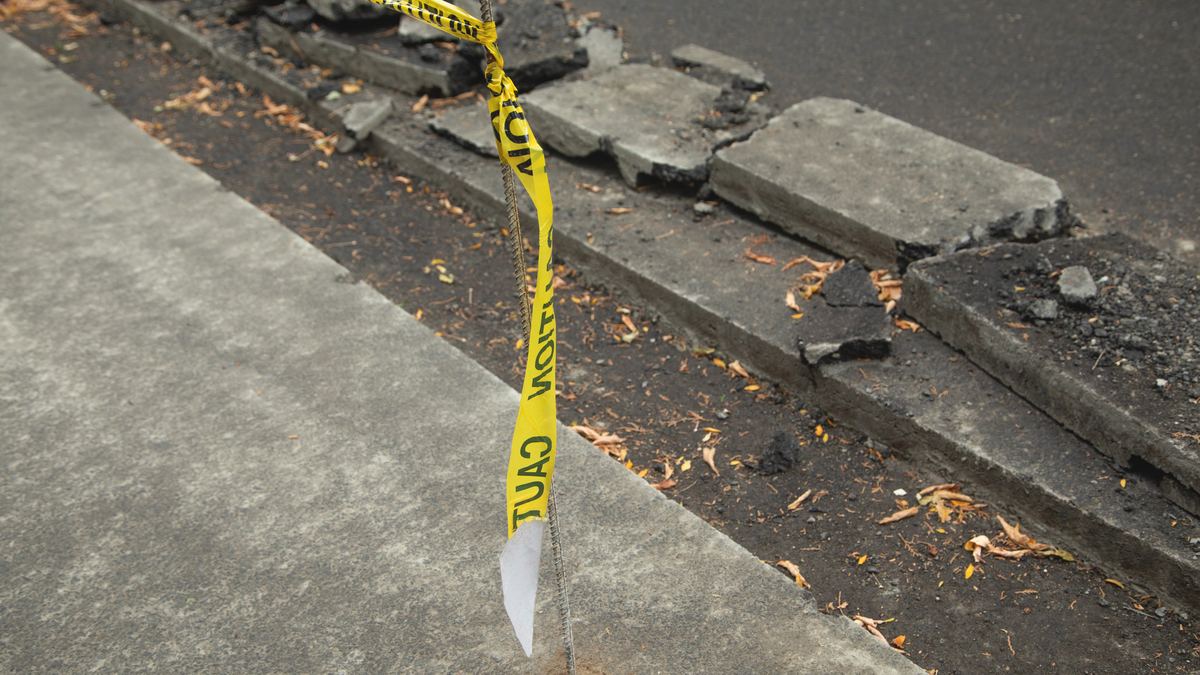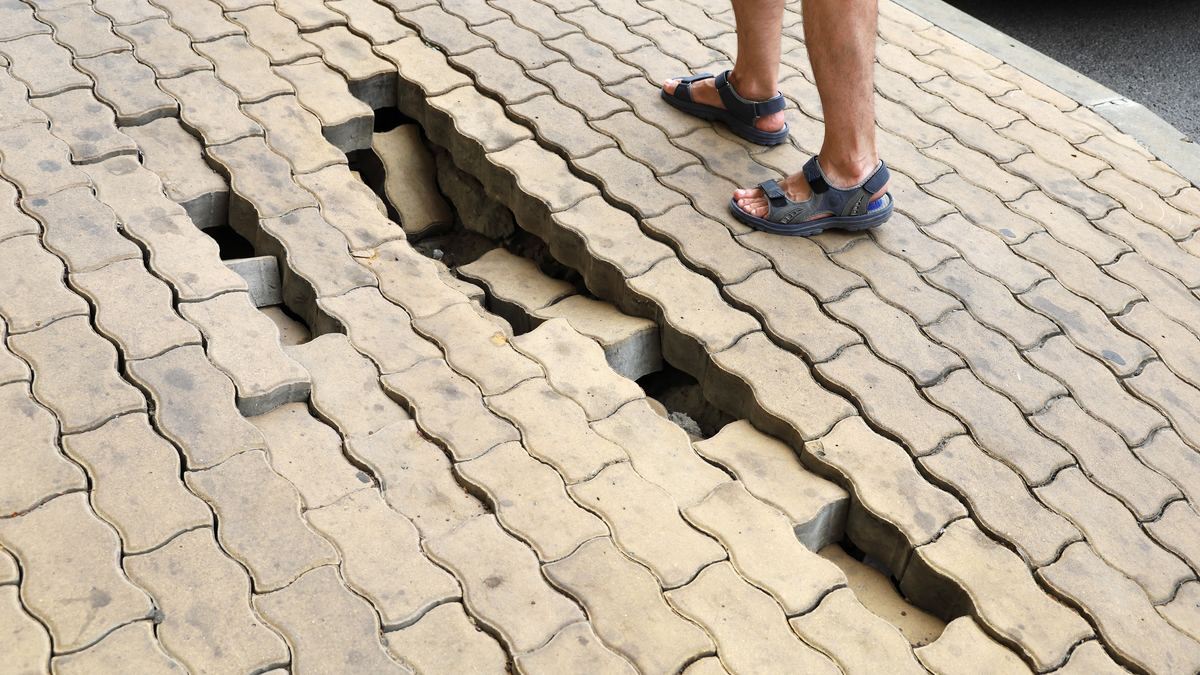
Did you trip on a broken paving slab on the pavement, fall and break your leg, ankle or arm? In that case you are entitled to claim compensation from the municipality, which is responsible for maintaining pavements. Sunken slabs, protruding edges, a broken kerb or a hole in the surface: every year, Bulgarian courts order municipalities to pay pedestrians injured in exactly this way amounts ranging from a few thousand to tens of thousands of leva.
In this article you will learn why the municipality is liable, what to do in the first hours after the fall, how injuries are proved with a forensic medical expert report, what damage is compensated, when the amount is reduced because of the victim's "carelessness" and what happens if the paving in front of a building is not municipal. You will also see real cases and the amounts awarded.
Why is the municipality liable for broken paving slabs?
The law requires the road manager to keep the road in good condition, to mark obstacles immediately and to remove them as quickly as possible (Art. 167(1) of the Road Traffic Act). In towns and villages, the municipality maintains municipal roads and streets (Art. 31 of the Roads Act), and even where a national road passes through a town, the municipality is responsible for the pavements (Art. 30(4) of the Roads Act).
When paving slabs are broken, displaced or sunken and nobody has repaired them or made them safe, the courts find that there has been unlawful inaction on the part of the employees to whom the municipality assigned maintenance. The claim is therefore a civil one under Art. 49 in conjunction with Art. 45 of the Obligations and Contracts Act (ЗЗД). You do not need to identify which employee was required to repair the pavement; it is enough to prove that the municipality failed to fulfil its duty.
Who has to prove that the pavement was maintained?
An important argument in favour of victims comes from case law. In a Sofia City Court case concerning a broken ankle on sunken paving slabs, the court held that the municipality must prove that it kept the pavement in a safe condition. The municipality produced no evidence either of the condition of the surface or of warning signs, and lost. In another case involving broken and missing slabs, the court noted that the municipality had neither claimed nor proved that it had done anything at all to make them safe.
This does not relieve you of the burden of proof. You must establish that you fell, exactly where, because of what defect, and what injuries you suffered. How the burden of proof is allocated on individual issues depends on the particular court and on the municipality's defence.
You will find an overall picture of claims against municipalities (for roads, manholes, trees and pavements) in our guide how to sue the municipality for damage caused by poor infrastructure.
What to do immediately after the fall
- Seek medical help the same day. Go to an emergency department or call an ambulance (112). This matters for your health and also for the case: a medical document with the date and a description of the injury is the main evidence.
- Tell the doctor how you were injured: "I fell on the pavement, I tripped on a broken paving slab". Ask for this to be recorded in the outpatient record (амбулаторен лист).
- Photograph the spot with a landmark. Take close-up photos of the defect (with an object for scale) and wide shots showing a building number, a street sign, a shop window or a junction. If you cannot do this yourself, ask someone who is with you, or go back in the following days before the paving is repaired.
- Note down the witnesses: names and phone numbers of the people who saw the fall or helped you.
- Submit a written report to the municipality (in Sofia, to the district administration or through the contact centre) describing the defect and giving the exact address. Keep the reference number.
- Keep all receipts: medicines, orthoses, dressings, examinations, rehabilitation, taxis, as well as your sick-leave certificates.
- Keep notes about the pain, sleeplessness, limitations in daily life and the help your family gives you; they will be needed for witness testimony.
From our practice: Do not put off seeing a doctor. In a Sofia City Court case, the victim treated herself for five days before going to a doctor and finding out that her ankle was broken. The claim was upheld, but every day of delay gives the municipality an argument that the injury may have been sustained elsewhere or may have worsened for other reasons.
How injuries are proved: medical documents and expert reports
Compensation is determined according to the severity of the injury and its consequences. To prove them, you will usually need:
- medical records: outpatient records from the emergency department, discharge summaries, X-rays, surgical reports, referrals for rehabilitation;
- sick-leave certificates: these show how long you were temporarily unable to work;
- a forensic medical expert report: appointed by the court; the expert establishes the type of injury and its mechanism, whether it is consistent with the fall described, the recovery period and whether there are lasting consequences;
- witnesses: family members who describe the pain, the limitations and the need for help from others;
- where needed, a psychological expert report: for example, if you are afraid to go out after the fall.
The forensic medical expert report is especially important when the municipality disputes that the injury resulted from this fall. The earlier and more detailed the description of the injury in the initial records, the easier the expert's task.
What damage is compensated?
Non-pecuniary damage
This means pain, suffering, inconvenience, fear, the loss of a normal way of life during treatment and lasting consequences. The compensation is set by the court on the basis of fairness (Art. 52 of the Obligations and Contracts Act). The court takes into account the type of injury, whether there was an operation, how long recovery took, the victim's age, whether help from others was needed and whether there are lasting limitations.
In the cases we look at below, the amounts awarded for non-pecuniary damage are in the range of BGN 7,000–30,000 for fractures, including those requiring surgery, and considerably more for serious and lasting injuries. Every case, however, is individual.
Pecuniary damage
This includes the costs actually incurred and proved:
- treatment: medicines, examinations, consumables, operations and implants, rehabilitation;
- care: paid help at home, transport to medical facilities;
- lost income: pay lost during the period of incapacity for work, to the extent it is not covered by sick-pay benefit.
Each cost must be proved with a document and must be linked to the injury.
Interest
In the case of a tort, the debtor is in default from the day of the damage (Art. 84(3) of the Obligations and Contracts Act), so statutory interest is usually awarded from the date of the fall. Since 1.1.2026, the rate has been the ECB's main refinancing rate plus 8 points (Council of Ministers Decree No. 347/2025).
Contributory fault: "she wasn't looking where she was going"
The municipality's most common defence is an objection of contributory fault (Art. 51(2) of the Obligations and Contracts Act): the victim could have seen the defect and avoided it. If the court upholds it, the compensation is reduced.
An example is the Sofia City Court case concerning a broken ankle in central Sofia. A witness stated that the defect was not visible, but the court found that a pedestrian walking calmly could notice the unevenness when approaching it and walk around it. The court set fair compensation at BGN 20,000 and reduced it to BGN 16,000 for contributory fault.
In other cases the same argument has been rejected, for example in Plovdiv, where the municipality claimed that the victim had not been looking where he was going, but the court did not accept this. The outcome depends on the facts: visibility and lighting, the size of the defect, whether the victim was carrying something or was in a hurry, whether the spot was fenced off or marked. Photographs taken from the pedestrian's position are the best answer to this argument.
Partial claim and a second claim for a later operation
Sometimes the victim does not claim the whole amount at once. A partial claim makes it possible to claim part of the compensation first (for example, to limit the court fee) and the remainder later. This was the case in one Sofia case, in which a total of BGN 80,000 was awarded through two separate claims. Note: as a rule, a partial claim does not interrupt the limitation period for the part not yet claimed, so the second claim must be filed in time.
Another situation is where new damage arises after the case, for example a second operation becomes necessary that was not foreseeable at the time of the first judgment. Case law allows compensation for such new, previously unknown damage by way of a separate claim, but the conditions are strict and depend on whether the damage was already covered by the first judgment. This is a question that requires a lawyer's assessment of the specific medical records.
If the paving is not municipal: shops and condominiums
Not every paving slab in front of a building is part of the municipal pavement. Liability depends on who owns the place where you fell:
- The public pavement is, as a rule, part of the street, and the municipality is liable.
- An area that is part of the building's or a commercial property's plot (a private yard, the steps up to an entrance, a forecourt in front of a shop within its own plot) may be the responsibility of its owner or user.
- If a business uses part of the pavement (for example for tables or a display) or has dug up the surface, it may also be liable, alongside the municipality.
The boundary between the street and private property is checked against the cadastral map and the title documents. Where it is unclear who is liable, it is sensible to check before filing the claim, so that you do not end up suing the wrong party. An instructive example comes from a manhole case in which the municipality was not held liable because the facility belonged to another company; see our article I fell into a manhole or trench: who pays?.
Real cases against municipalities for falls on the pavement
The following cases have been reported in the media. Amounts are in leva as reported, with their approximate equivalent in euro.
- Sofia City Court, 2020: a 56-year-old woman trips on broken concrete and protruding reinforcement bars on the corner of Lege Street and Saborna Street; broken ankle. The court finds BGN 20,000 (≈ EUR 10,226) to be fair compensation and reduces it to BGN 16,000 (≈ EUR 8,181) for contributory fault; the municipality did not prove that it had maintained the pavement. The judgment was reported as subject to appeal.
- Sofia City Court, 2020: a 70-year-old woman falls on broken, missing and warped paving slabs on William Gladstone Street and breaks both arms. BGN 12,000 (≈ EUR 6,136) is awarded against a claim of BGN 40,000. The judgment was not final at the time of the report.
- Sofia, 2024: a woman trips in a hole in the pavement while hurrying to catch a trolleybus at a stop in the city centre, and the trolleybus runs over her legs. A total of BGN 80,000 (≈ EUR 40,903) is awarded through two partial claims, of BGN 35,100 and BGN 44,900.
- Plovdiv, 2022: a man steps into a hole formed by displaced paving slabs in his neighbourhood; torn meniscus, operation. BGN 15,000 (≈ EUR 7,669) is awarded; the objection that he had not been looking where he was going is not accepted.
- Plovdiv, 2025: a woman trips on displaced paving slabs and a broken-off kerb and breaks her right arm, requiring an operation. The municipality is ordered to pay her BGN 10,000 (≈ EUR 5,113) in compensation.
- Shumen Regional Court, 2022: a 75-year-old woman falls on broken paving slabs on Rishki Prohod Boulevard and breaks her shoulder; operation with an implant. BGN 7,000 (≈ EUR 3,579) in compensation and BGN 1,510 (≈ EUR 772) in pecuniary damages for the operation and the implant are awarded. The judgment is final.
- Montana Regional Court, 2025: a 76-year-old man trips on a poorly maintained pavement; operation on his right arm. BGN 30,000 (≈ EUR 15,339) in non-pecuniary and BGN 2,655 (≈ EUR 1,357) in pecuniary damages are awarded.
How the case against the municipality proceeds
- Consultation and analysis: reviewing the medical documents, photographs and witnesses, determining who is liable and what amount of claim is justified. If you are choosing a lawyer, see which questions to ask a lawyer.
- Letter of demand to the municipality: optional; municipalities rarely pay voluntarily, but their reply shows what defence they will choose.
- Statement of claim: stating separately the amounts for non-pecuniary and pecuniary damage, with the evidence and the paid court fee.
- The municipality's response: it usually disputes the fact of the fall, the place, the causal link and the amount, and raises an objection of contributory fault.
- Evidence: witnesses, a forensic medical expert report and, where needed, information from the municipality about repairs to the section.
- Judgment and appeal: once the judgment is final, the municipality pays the compensation, interest and costs.
Deadlines, fees and which court
| Question | Answer | Legal basis |
|---|---|---|
| Limitation period | 5 years | Art. 110 of the Obligations and Contracts Act |
| Runs from | Identification of the person responsible (usually the day of the fall) | Art. 114(3) of the Obligations and Contracts Act |
| Interest | Statutory interest from the date of the damage | Art. 84(3) of the Obligations and Contracts Act |
| Court fee | 4% of the amount claimed, minimum EUR 25.56 | Tariff of State Fees under the Civil Procedure Code |
| Exemption from the fee | Where the claimant lacks sufficient means, at the court's discretion | Art. 83(2) of the Civil Procedure Code |
| First instance | District Court (районен съд); Regional Court (окръжен съд) for claims over BGN 25,000 (≈ EUR 12,782) | Art. 104(4) of the Civil Procedure Code |
A similar logic (civil liability of the municipality for inaction) applies to other incidents in the street, for example a stray dog bite. For a tort claim, speak to a personal injury lawyer.
Frequently Asked Questions (FAQ)
Can I sue the municipality if I fell because of a broken paving slab?
Yes. The municipality is liable under Art. 49 of the Obligations and Contracts Act for the inaction of its employees who failed to repair the pavement or make it safe. You must prove the fall, the place, the defect and the injuries. The general approach is described in our guide how to sue the municipality for infrastructure damage.
How much money can I get for a broken leg or arm?
There is no fixed amount: non-pecuniary damage is set on the basis of fairness (Art. 52 of the Obligations and Contracts Act). In the reported cases, the amounts for fractures are in the range of BGN 7,000–30,000, and considerably more where the consequences are serious. Pecuniary damage is reimbursed according to the costs proved.
Do I have to see a doctor the same day?
Yes, it is advisable. The emergency department document with the date and a description of the injury is the main evidence. A delay allows the municipality to argue that the injury was sustained elsewhere.
Will the court reduce the compensation if I wasn't looking where I was going?
It may, if the municipality proves contributory fault (Art. 51(2) of the Obligations and Contracts Act). In one Sofia case the amount was reduced from BGN 20,000 to BGN 16,000, while in a Plovdiv case the same objection was rejected. The outcome depends on how visible the defect was and the specific circumstances.
Who is liable if I fell into a manhole rather than on a paving slab?
It depends on who owns the manhole: the municipality, the water utility, or an energy or telecoms company. We explain this in detail in our article I fell into a manhole or trench: who pays?.
Is the municipality liable for the paving in front of a shop or residential building?
It depends on who owns the spot. The public pavement as a rule belongs to the municipality, but an area within the plot of the building or a commercial property may be the responsibility of its owner or user. This is checked against the cadastral map and the title documents.
Can I also recover my lost wages?
Yes, income lost during the period of incapacity for work is compensated as pecuniary damage, to the extent it is proved and not covered by sick-pay benefit. You will need sick-leave certificates and documents proving your income.
What happens if I need another operation after the case?
Case law allows a separate claim for new damage that was not known or foreseeable at the time of the first judgment. The conditions are strict, so an assessment based on the medical records is needed.
How long do I have to bring a case?
The limitation period is 5 years (Art. 110 of the Obligations and Contracts Act) and runs from the identification of the person responsible (Art. 114(3)), usually from the day of the fall. Do not wait: the defect may be repaired and witnesses may forget.
How much does a case against the municipality cost?
The court fee is 4% of the amount claimed, but not less than EUR 25.56, plus deposits for expert reports and the lawyer's fee. We explain how to choose a litigation lawyer in our article how to choose a good lawyer.
Is the municipality also liable for other incidents in the street?
Yes, for example for a stray dog bite or for damage to your car from a pothole. See our articles on dog bites and compensation from the municipality and accidents caused by a pothole.
How can we help you?
Pavement fall cases are won with evidence gathered quickly: a medical document from the same day, photographs of the defect with a landmark, and witnesses. The municipality almost always disputes how the fall happened and raises an objection of contributory fault, so preparation from day one is decisive for the amount of compensation.
Mechkova & Dimitrova Law Firm will assess who is responsible for the spot, help you gather medical and witness evidence, draft the statement of claim and represent you in court. The information in this article is general and does not guarantee any particular outcome. Contact us to have your case reviewed.