A fall into a manhole or trench is one of the most common causes of broken ankles, knees and arms in towns and cities, and one of the types of case that victims most often lose, not because they have no right to compensation, but because they sued the wrong defendant. The cover on the pavement may belong to the municipality, the water utility (ВиК operator), the electricity distribution company, the district heating company or a mobile operator. The trench may belong to a construction company working on behalf of one of them. Compensation for a fall into a manhole is due, but only from whoever is actually responsible for the facility or the section.
You will learn how to establish whose manhole it is, how to sue several defendants, what you need to prove, when compensation is reduced and what amounts the courts award. The general framework for claims against the municipality for poor infrastructure is described in our guide how to sue the municipality for damage caused by poor infrastructure.
Who is liable for a fall into a manhole or trench?
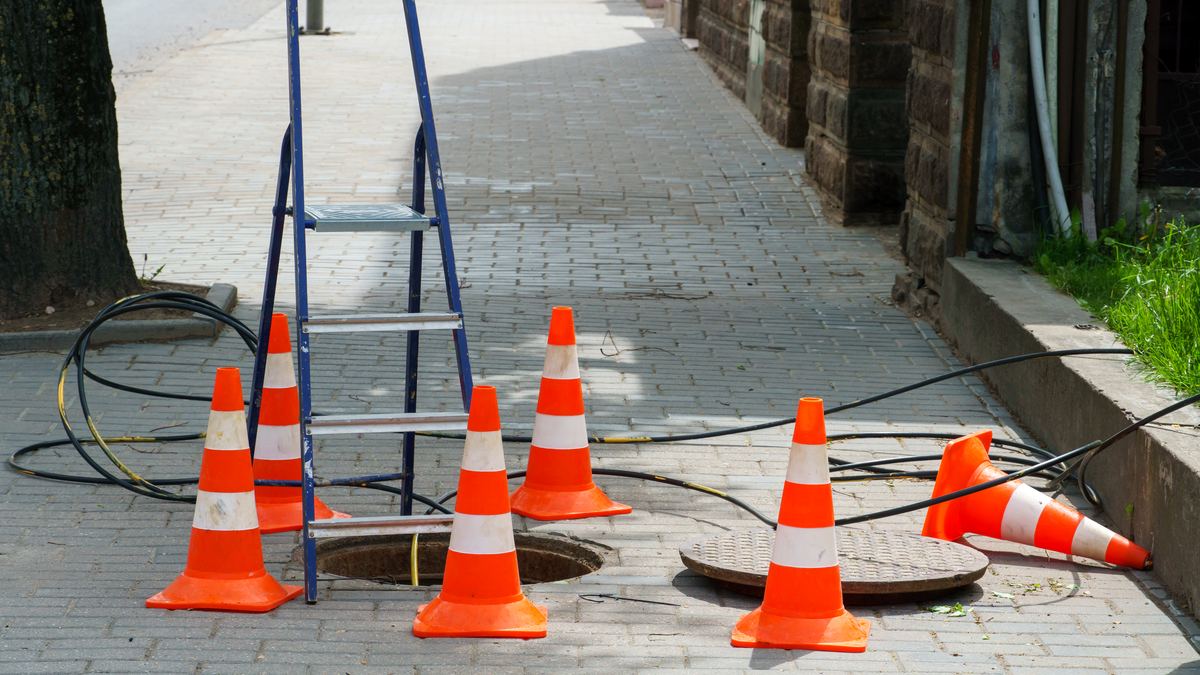
Networks belonging to different owners run under streets and pavements. Each network has its own manholes, and every owner or operator is required to keep its facilities in a safe condition. The most common scenarios are:
| Type of manhole or trench | Usual responsible party | What to check |
|---|---|---|
| Street manhole or grating with no markings | The municipality or the water utility, depending on the network and the town | Enquiry to the municipality; who maintains the street |
| Water supply or sewerage manhole | The water utility for the relevant area | Lettering or logo on the cover; enquiry to the water utility |
| Electrical or cable manhole on the pavement | The electricity distribution company | Logo on the cover; location next to a transformer station |
| District heating manhole | The district heating company | Lettering, proximity to the heating network |
| Telecommunications manhole | Telecoms, cable or mobile operator | Logo or abbreviation on the cover |
| Trench from repairs or construction | The contractor, its client and sometimes the municipality | Site sign, works permit, contract |
The table is a guide: ownership is established from documents.
The legal basis
Claims for a fall into a manhole are civil claims. When a legal entity is sued (the municipality, the water utility, the energy company), the courts usually consider them under Art. 49 in conjunction with Art. 45 of the Obligations and Contracts Act (ЗЗД): liability for damage caused by the persons tasked with maintenance work, including through unlawful inaction. Some cases also discuss Art. 50 of the Obligations and Contracts Act, under which the owner and the person in whose care a thing is are jointly and severally liable for damage caused by it. Which of the two provisions the court applies depends on the facts and on the particular panel, so the statement of claim must describe the circumstances in full.
A case against the municipality is not brought under the State and Municipalities Liability for Damage Act (ЗОДОВ), but under the general procedure of the Civil Procedure Code (ГПК).
Whose manhole is it? How to find out before going to court
This is the most important question in the whole case. If you sue a party that is not the owner and is not responsible for maintenance, the claim will be dismissed, and you will owe the defendant's costs.
The cover and the location
- Photograph the cover close up. Many covers bear the logo, abbreviation or name of the company they belong to.
- Also photograph it from a distance, with a landmark: a building, a number, a pedestrian crossing. This proves the exact location and whether the manhole is on the pavement, in the carriageway or in a green area.
- Pay attention to the surroundings: a transformer station, a construction site sign, barriers, signs of recent repairs. These point to the operator or the contractor.
The lettering on the cover is an important indication, but not always conclusive proof: covers are replaced and networks change hands. So it is best to confirm it in writing.
Written enquiries to the municipality and the operators
- Send a written enquiry to the municipality (in Sofia, also to the district administration), describing the exact location and attaching photographs. Ask them to tell you whose manhole it is and who maintains the section. The report also records the date and the condition of the manhole.
- Also send enquiries to the operators the facility may belong to: the water utility, the energy company, the district heating company. A reply saying "it is not ours" is also useful, because it narrows the field.
- Use the Access to Public Information Act (ЗДОИ). The municipality is an obliged body and must decide on the request no later than 14 days after it is registered (Art. 28(1) of the Access to Public Information Act). You can ask for information on permits issued for digging at the location, repairs commissioned and earlier reports about the same manhole. Whether a particular company (for example a water utility) is an obliged body under the Act depends on its legal status; check this in the specific case.
From our practice: Do not wait for the case to find out whose manhole it is. Once you file the claim, the defendant has been chosen. If it later turns out that the facility belongs to someone else, replacing the defendant under Art. 228 of the Civil Procedure Code is possible only with the consent of both parties and of the new party, which in practice is rarely achieved.
A trench from repairs or construction: the contractor, the client or the municipality?
Several parties are usually involved in an excavation: the client (for example the water utility, the energy company, the municipality or a private developer), the contractor (the construction company doing the digging) and the municipality, which issues permits for work on the streets and has supervisory powers over public areas.
- The contractor is usually the party that actually controls the trench; it must fence it off, mark it and, where necessary, light it. An unfenced and unlit trench is often the most direct argument for its liability.
- The client may be liable together with the contractor, but whether and on what basis depends on the relationship between them (contract, supervision, instructions) and on the court's assessment. Case law on this point is not uniform.
- The municipality is responsible for safe passage along streets and pavements. In a number of cases the courts have held that it must ensure safe movement in public areas, including while repairs are being carried out there.
The rules on construction sites, digging permits and supervision are contained in the Spatial Development Act (ЗУТ), its implementing regulations and the ordinances of the relevant municipality. They differ between municipalities, so for every excavation check what permit was issued and to whom.
Where damage is caused by several persons, they are jointly and severally liable (Art. 53 of the Obligations and Contracts Act). This means that if the court finds more than one defendant liable, you can recover the full compensation from any of them.
How to sue several defendants in one case
When it is not certain who is liable, one option is to bring the claim against several defendants in a single statement of claim, for example against the municipality and the water utility, or against the contractor and the client. The court will establish in the proceedings whose manhole it is and who breached their obligations.
Advantages and risks:
- Plus: you do not lose time on a new case if it turns out that the other party is liable; the limitation period is interrupted as against all the defendants.
- Minus: if the claim against one of the defendants is dismissed, you will, as a rule, owe that defendant's costs, including the lawyer's fee.
- Alternative: a defendant may itself join another party as a third-party intervener (Art. 219 of the Civil Procedure Code), and the claimant can also do so at the first hearing. The judgment will then also have effect in the relations between them.
If you are still choosing a litigation lawyer, see what to ask a lawyer before going to court.
What you must prove, and what the defendant must prove
Each party must establish the facts on which it bases its claims or objections (Art. 154(1) of the Civil Procedure Code). For a fall into a manhole, this means in practice:
You prove:
- the fall itself: the place, date and time (witnesses, medical documents, a call to 112 or a report to the municipality);
- the condition of the manhole or trench: an open or broken cover, a sunken cover, no fencing or markings, no lighting;
- who is responsible for the facility: ownership or a duty to maintain it;
- the damage: the injuries, treatment, pain, costs;
- the causal link between the fall and the injuries, usually through a forensic medical expert report.
The defendant proves:
- that it maintained the facility and the section: inspections, repairs, reports it responded to;
- contributory fault, if it alleges it, with specific facts.
In the case of a tort, fault is presumed until the contrary is proved (Art. 45(2) of the Obligations and Contracts Act). In cases involving sunken paving slabs and manholes, the courts hold that the municipality bears the burden of proving that it kept the section in good condition. For more on this logic in relation to uneven pavements, see our article I tripped on a broken paving slab: compensation from the municipality.
Contributory fault: darkness, signs and "why did you go that way?"
Defendants almost always raise an objection of contributory fault under Art. 51(2) of the Obligations and Contracts Act: that the victim could have seen the manhole, was walking on the grass, was distracted or went somewhere they "should not have". If the objection is proved, the compensation is reduced.
The courts assess specifically:
- Lighting. If the spot was dark and the trench was not lit, a pedestrian can hardly be expected to notice it.
- Markings and fencing. The absence of a fence and warning signs at the trench itself counts against the defendant. Fencing somewhere else nearby is no substitute for fencing off the dangerous section.
- The pedestrian's route. Walking across a green area or along a trodden path is not necessarily contributory fault in itself.
In the case of the excavation near the National Palace of Culture (НДК) (see below), the municipality argued that the young man should not have been there and had become disoriented in the dark. Both instances rejected the objection: the victim could not have foreseen and prevented the fall with the attention normally expected of a pedestrian. In a case against Sofiyska Voda (the Sofia water utility), the court likewise did not accept the argument that the victim had been walking on the grass rather than on the pavement.
From our practice: The objection of contributory fault must be proved by the defendant. Good photographs of the spot (especially evening photos, if the incident happened in the dark) are often the strongest answer to it.
Real cases against municipalities and operators
The cases below are described as reported in legal and news publications. Amounts from before 2026 are in leva as reported, with the approximate equivalent in euro.
- National Palace of Culture, trench with no fencing or lighting: BGN 180,000 (≈ EUR 92,033), final. In spring 2015 a 17-year-old falls into a three-metre-deep trench near the National Palace of Culture during repair works. The path is unlit, and there is no fence or warning at the trench. The Sofia City Court awards BGN 180,000 in non-pecuniary damages against Sofia Municipality (against a claim of BGN 200,000), the appellate court upholds the judgment, and the Supreme Court of Cassation refuses to allow a cassation appeal (2022). Contributory fault is rejected. The victim has undergone three operations and has lasting consequences.
- Sofia Municipality: 11 manhole cases lost, over BGN 155,000 (≈ EUR 79,250) in about a year. A 2021 review on a legal portal describes 11 cases, decided mostly in 2020, with compensation of between BGN 5,000 and 35,000 (≈ EUR 2,556 – 17,895). Among them: BGN 35,000 (final) for a broken kneecap after a fall into an open, unmarked manhole on a pedestrian crossing in Lyulin; BGN 20,000 (final) for a woman whose leg went through an uncovered manhole in the carriageway after she got out of her car; BGN 12,000 (final) for a dislocated shoulder and broken arm caused by a broken cover with no warning sign. In one of the cases, for BGN 10,000, the court took into account in setting the amount that the victim had not sought medical help immediately.
- Sofiyska Voda: BGN 40,000 (≈ EUR 20,452). The Sofia City Court awards compensation to a woman who in 2018 fell into an uncovered round manhole in Lyulin and broke her ankle. The objection that she had been walking on the grass is rejected. The report does not say whether the judgment is final.
- CEZ: BGN 60,000 (≈ EUR 30,678), final (Supreme Court of Cassation, 2020). In 2010 a man slips and falls on an unsecured, slippery and sloping manhole on Alabin Street in Sofia, and dies before the final judgment. The compensation is awarded to his heirs against the electricity distribution company. Sofia Municipality took part in the case as a third-party intervener.
- Plovdiv: a case lost because the manhole belonged to a mobile operator. In 2025 a man who fell into an unsecured manhole and broke a toe claimed BGN 20,000 (≈ EUR 10,226) from Plovdiv Municipality. The court dismissed the claim because the facility belonged to a mobile operator. This is the clearest example of why ownership of the manhole must be established before the case.
- Plovdiv: BGN 5,000 (≈ EUR 2,556) for a drummer's broken finger. The car the musician is travelling in drives into an unsecured manhole on Ibar Street. He breaks a finger and is unable to play for months. Plovdiv Municipality is also held liable at second instance (2026); his fellow passenger receives BGN 1,000 (≈ EUR 511).
The lesson: the municipality loses when the section is its own and was not made safe; operators lose when the facility is theirs; and the victim loses when the claim is brought against the wrong defendant.
What to do immediately
- Seek medical help the same day, at an emergency department or from your GP. Ask for an outpatient record (амбулаторен лист) or discharge summary (епикриза) describing the mechanism of the injury, the place and the date. Delay may affect the amount of compensation.
- Photograph the manhole or trench with a landmark (a building, a sign, a street number), both close up (the cover, the lettering, the missing fencing) and from a distance.
- If it is dark, also photograph the lighting, or the lack of it. If possible, go back at the same time the following evening.
- Write down the names and phone numbers of witnesses. They are often the only evidence of what the spot looked like at the moment of the fall.
- Submit a written report to the municipality (and to the operator, if the cover is marked), with a description, photographs and a request for them to identify the owner of the facility. Keep the reference number.
- Keep all receipts: medicines, orthoses, crutches, rehabilitation, transport, lost income.
What compensation is awarded for a fall into a manhole
Non-pecuniary damage
Pain, suffering, limitations in daily life, fear and lasting consequences are compensated on the basis of fairness (Art. 52 of the Obligations and Contracts Act). The court assesses the type of injury, the number of operations, the length of treatment and rehabilitation, the victim's age and the consequences for their work and personal life.
As a rough guide, based on the cases described above and other published cases involving falls into manholes and on pavements:
| Severity of the injury | Amounts awarded in published cases |
|---|---|
| Simple fracture, no surgery | BGN 5,000 – 20,000 (≈ EUR 2,556 – 10,226) |
| Fracture with surgery, pins or a plate | BGN 15,000 – 35,000 (≈ EUR 7,669 – 17,895) |
| Injuries with lasting consequences for daily life | BGN 40,000 – 80,000 (≈ EUR 20,452 – 40,903) |
| Permanent disability | up to BGN 180,000 (≈ EUR 92,033) |
This is not a tariff: every case is assessed individually, and the amounts in practice change over time.
Pecuniary damage and interest
Proven costs of treatment, rehabilitation and mobility aids are reimbursed, as well as lost income. Statutory interest is due on the compensation; in the case of a tort the debtor is in default even without a demand (Art. 84(3) of the Obligations and Contracts Act), so interest usually runs from the day of the fall.
If it was your car rather than you that was damaged (for example a tyre or wheel rim in an open manhole in the carriageway), the logic is similar, but the proof and the defendants are different. See our article on pothole accidents and compensation for your car.
Deadlines, fees and which court
| Question | Answer | Legal basis |
|---|---|---|
| Limitation period | 5 years | Art. 110 of the Obligations and Contracts Act |
| Runs from | Identification of the person responsible | Art. 114(3) of the Obligations and Contracts Act |
| Court fee | 4% of the amount claimed, minimum EUR 25.56 | Tariff of State Fees under the Civil Procedure Code |
| First instance | District Court (районен съд); Regional Court (окръжен съд) for claims over BGN 25,000 (≈ EUR 12,782) | Art. 104(4) of the Civil Procedure Code |
| Venue | May also be where the damage occurred | Art. 115(1) of the Civil Procedure Code |
| Interest | Statutory interest from the day of the damage | Art. 84(3) of the Obligations and Contracts Act |
For a fall into a manhole, the limitation period runs from the time the person responsible for the damage is identified. Where the owner of the manhole is not known, the starting point may be disputed; do not rely on this, and act within 5 years of the fall. A personal injury lawyer in Sofia can tell you more about compensation claims under the Obligations and Contracts Act.
Frequently Asked Questions (FAQ)
Who pays if I fall into an open manhole on the pavement?
The owner or the party responsible for maintaining the manhole pays: the municipality, the water utility, the electricity distribution company, the district heating company or a telecoms operator. That is why you need to establish whose manhole it is before the case. The general logic of claims against the municipality is described in our guide how to sue the municipality for poor infrastructure.
How do I find out whose manhole it is?
Start with the lettering or logo on the cover and photographs of the spot. Then send a written enquiry to the municipality and to the possible operators and, if needed, a request under the Access to Public Information Act, to which the municipality must reply within 14 days. The replies are attached to the statement of claim.
Can I sue the municipality and the water utility at the same time?
Yes, the claim can be brought against several defendants in a single statement of claim, and the court will establish who is liable. The risk is that if the claim against one of them is dismissed, you will, as a rule, owe that defendant's costs. For how to discuss this strategy with your lawyer, see our article how to choose a good lawyer.
What happens if I sued the wrong defendant?
The claim will most likely be dismissed, as in a Plovdiv case in which the manhole turned out to belong to a mobile operator. Replacing the defendant during the case is possible only with the consent of everyone concerned, so a new case against the right party is often needed, provided the limitation period has not expired.
Who is liable if I fall into a construction company's trench?
Usually the contractor, which controls the trench and must fence it off, mark it and light it. The client may also be liable, and in some cases so may the municipality, which must ensure safe passage in public areas. Exactly who is liable depends on the facts and on the court's assessment.
Is compensation reduced if it was dark and I didn't see the manhole?
Not automatically. If the spot was not lit or marked, this usually counts against the defendant, not against you. Contributory fault must be proved by the defendant; in the case of the trench near the National Palace of Culture, the courts rejected it and awarded BGN 180,000.
How much compensation is there for a broken ankle after a fall into a manhole?
There is no fixed amount: the court sets non-pecuniary damage on the basis of fairness. In published cases of broken ankles from falls into manholes, the amounts range from about BGN 5,000 to 40,000, and considerably more for permanent disability. Compare also the case law on broken legs from sunken paving slabs.
What is the limitation period for a claim for a fall into a manhole?
The limitation period is 5 years (Art. 110 of the Obligations and Contracts Act) and runs from the identification of the person responsible (Art. 114(3)). Where the owner is not known immediately, the starting point may be disputed, so it is safer to act within 5 years of the fall.
How much does the case cost?
The court fee is 4% of the amount claimed, but not less than EUR 25.56, plus the costs of expert reports and a lawyer. If you win, the defendant reimburses your costs in proportion to the part of the claim upheld. Details of the fees and the court are also in our article on compensation from the municipality for a dog bite, where the same rules apply.
If my car drops into a manhole, whom should I sue?
The owner of the manhole or the party that maintains the road is liable if the manhole has no cover or has sunk. If you have comprehensive (Casco) motor insurance, the insurer may pay and then recover the amount from the party responsible. See our article on potholes and compensation for your car.
How can we help you?
With a fall into a manhole or trench, the most important decision is made before the case: against whom to bring the claim. The wrong defendant means a lost case and costs, even when the damage is undisputed. That is why we first clarify who owns the facility and who was responsible for the section.
Mechkova & Dimitrova Law Firm will gather information on the owner of the manhole or the contractor responsible for the trench, assess the evidence and represent you against the municipality, the operator or the construction company. The information here is general and does not guarantee any particular outcome. Contact us to have your case reviewed while the spot and the witnesses are still available.